You need proof, not reassurance.
Families arriving at this page have usually been told something frightening. So this is the longest page on our site: what our caregivers are trained to do, how we handle the hard hours, and what we can't do.
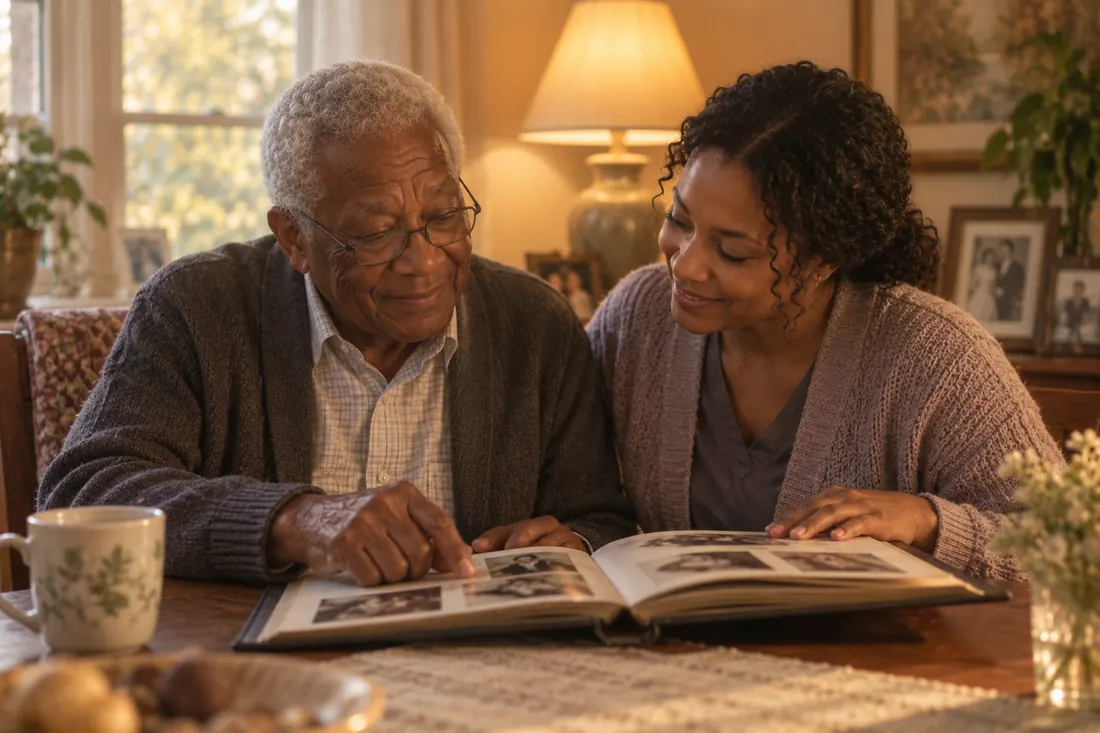
Continuity is the whole thing
With dementia, a new face every week undoes the work. Someone who has never met your father doesn't know that he gets anxious near the front door at four o'clock, or that he'll accept help from a person who sits down first.
So we assign a small, fixed team — usually two caregivers — and we protect it. You'll know both by name. When one is away, the other is already familiar. We'd rather turn down a case than staff it with whoever is free.
How we handle the hard parts
Sundowning
Agitation in the late afternoon is predictable, so we schedule around it — a caregiver already present before it starts, lights on early, the day's demanding tasks done in the morning, and a calm activity held back for that hour.
Wandering
We walk the home with you and find the exits, the stairs and the hazards. Caregivers are trained to redirect rather than block, because blocking escalates. Where wandering is a real risk, we'll say plainly if the hours you're considering are enough.
Repetition and confusion
We don't correct or argue. Being told your husband has died, freshly, for the fourth time in a day is cruel and achieves nothing. Our caregivers are trained to meet the person where they are and move gently to something else.
Refusing care
Resistance is usually fear, not stubbornness. We slow down, break tasks into smaller steps, and come back to it. A bath that happens on the third attempt is a success.
Aggression
It happens, it isn't personal, and our caregivers are trained not to take it that way. We de-escalate, give space, and log it so patterns become visible. If behaviour changes suddenly, we call you the same day — a sudden change often has a medical cause, like an infection.
What we can't do
We are a non-medical agency. We don't administer medication, manage medical devices, or provide nursing care. We aren't a locked facility, and we can't guarantee someone won't leave the house.
If your family member's needs have moved past what home care can safely hold, we will tell you. That conversation is uncomfortable, and we'd rather have it with you than let a bad situation continue because it's good for our business.
- Minimum visit3 hours
- Caregiver teamFixed, usually 2
- Overnight awake$43/hr
- Holidays1.5×
Higher than our other services because these caregivers are trained specifically for dementia and paid accordingly.
What that works out to
- Afternoons through sundowning, 4 hours daily — about $4,070 a month
- Weekday full days, 40 hours — about $8,140 a month
- Overnight awake cover, 7 nights — about $15,600 a month
Compare against memory care facilities in Massachusetts, which average around $9,840 a month. Below roughly 45 hours a week, home is usually the less expensive option — and we'll be honest with you about where that line falls for your family.
Talk it through with Amalia
Bring your questions, including the ones you're afraid to ask. The assessment is free and there's no pressure to book anything.